Transitioning Landscape Maintenance Between Contractors: The Handover Checklist
By Paul V. Mascarinas · July 11, 2026
A proper landscape maintenance handover is a documented, joint condition baseline — not a set of keys and a goodbye. At minimum it needs an as-found audit of every zone, a plant inventory with health status, an irrigation controller and zone map, a record of outstanding defects, and a clear statement of what warranty coverage (if any) survives the transition. Skip this and the incoming contractor inherits undocumented liability for problems that predate them — which is exactly the dispute facilities managers spend the next year untangling.
 An established landscape under an active maintenance program, Batangas — the kind of condition a handover baseline needs to document precisely
What is an “as-found baseline” and why does it matter?
An as-found baseline is a dated record — written and photographed — of the landscape’s exact condition at the moment maintenance responsibility changes hands. It’s the single reference point that separates “this was already declining when we took over” from “this declined on our watch.”
We’ve inherited maintenance accounts where no baseline existed at all: the previous contractor was simply gone, and the property manager’s only record was a vague sense that “it used to look better.” That’s an unwinnable position for everyone — the incoming contractor can’t prove what they inherited, and the facilities manager can’t hold anyone accountable for what changed afterward. A baseline fixes that in one site visit, if it’s done properly and on time.
What should a full handover checklist include?
- As-found condition audit, by zone. Photographed and dated coverage of every planted area, hardscape element, and irrigation zone, with a written condition rating (good / fair / declining / dead) for each.
- Plant inventory and health record. A count and species list per zone, cross-referenced against the original planting plan if available, noting any plants missing, replaced off-spec, or in visible decline.
- Irrigation controller and zone map. Which controller runs which zone, current schedule and run times, known dead zones or faults, and physical location of each controller and valve box.
- Warranty status. What plant or workmanship warranties are still active, from whom, until when, and under what conditions they remain valid — see our companion guide on how plant warranties should be structured for what “still valid” should actually mean.
- Outstanding defect and issue log. Every known unresolved problem — pest pressure, irrigation faults, structural planter issues, drainage complaints — logged with date first noticed, not folded silently into “general condition.”
- Access and safety information. Gate codes, restricted areas, working-at-height requirements, any site-specific safety protocols the incoming crew needs on day one.
- Documentation handover. As-built irrigation drawings, planting plans, prior maintenance logs or reports, and contact history for recurring issues.
- Joint sign-off. A dated record signed by the outgoing contractor, incoming contractor, and the facilities manager or owner’s representative, confirming all parties reviewed the same baseline.
Who should be at the handover walkthrough?
All three parties, together, whenever possible: the outgoing contractor, the incoming contractor, and the facilities manager or owner’s representative. A joint walkthrough produces one shared record instead of two conflicting ones — and it’s the version that actually holds up if a warranty or liability question comes up later.
On a maintenance account we inherited at a commercial high-rise, the outgoing contractor’s participation ended before a joint walkthrough could happen — a common outcome when the prior relationship ended on bad terms. Rather than skip the baseline, we completed a full as-found condition record with the facilities manager alone, explicitly noted in the documentation that the outgoing contractor had been invited and did not participate, and dated everything before starting any new maintenance work. That single step meant six months later, when a question came up about a planter that had been declining for some time, there was a record showing it was already in that condition on day one — not a dispute.
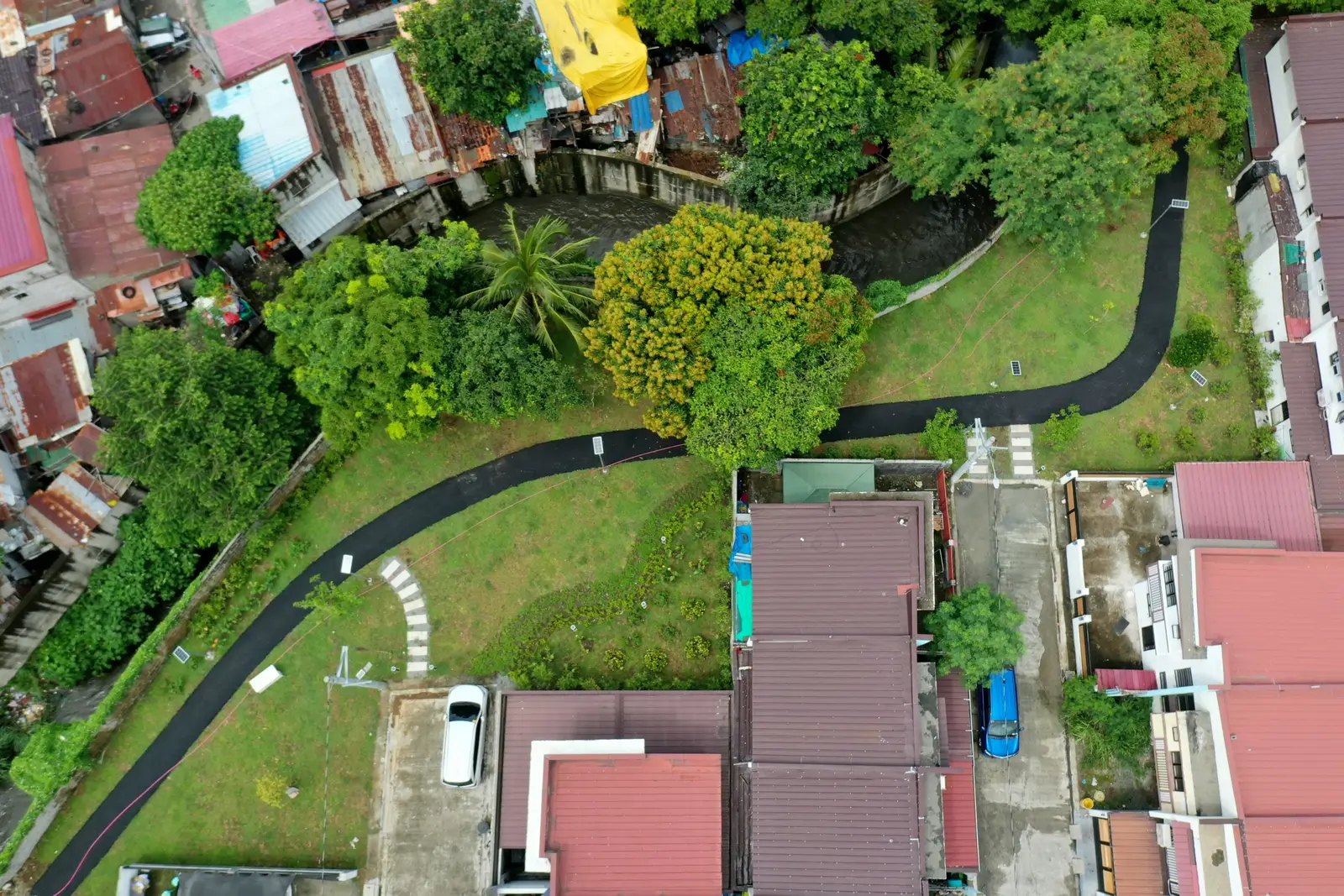 A maintained community greenway, Jubilation Enclave North — the kind of common-area zone that needs its own line in a handover baseline
What if the outgoing contractor won’t cooperate?
Don’t let their absence stop the baseline from happening. Proceed with the incoming contractor and the facilities manager, document the condition thoroughly, and note the non-participation in writing. This protects the incoming contractor from being assumed responsible for pre-existing issues, and gives the facilities manager a clean record to fall back on regardless of how the prior relationship ended.
How does warranty status factor into a handover?
Plant and workmanship warranties are tied to the contractor performing the work during the warranty period — they don’t travel automatically with the property when maintenance changes hands. Every handover should include an explicit warranty check: what’s still covered, by which party, and under what conditions it remains valid (continuous maintenance by the original contractor is a common condition, and one that a handover by definition interrupts). Assume nothing carries over without checking — see our guide on retention and warranty structuring for the mechanics.
How long should this take, and what does it cost to skip it?
Budget one to two site visits over about a week for a mid-sized commercial or institutional account — enough time to walk every zone, map irrigation properly, and get all three parties to sign the same document. The cost of skipping it isn’t visible immediately. It shows up months later as an unresolvable argument about who let a hedge die, or a warranty claim nobody can substantiate either way. A one-week baseline is materially cheaper than that conversation.
If MEG is stepping into an existing maintenance account — whether taking over from a previous contractor or bringing an in-house team’s landscape under a formal contract — a documented handover like this is step one, not an afterthought. It’s also the foundation for the maintenance SLA that governs the account going forward, and pairs with sound corporate and developer landscape planning from the outset.
Inheriting a landscape maintenance account, or transitioning off one? Book a consultation with MEG to run a proper handover baseline before responsibility changes hands.
Frequently asked questions
What is an as-found baseline in a landscape maintenance handover?
It's a dated, photographed, written record of the landscape's exact condition at the moment a new maintenance contractor takes over — plant health, irrigation function, hardscape condition, and any existing defects. It matters because it draws the line between problems the incoming contractor inherited and problems that develop on their watch. Without it, every future issue becomes a dispute about who's responsible.
Who should be present for a maintenance handover inspection?
Ideally both the outgoing and incoming contractor, plus the facilities manager or owner's representative. A joint walkthrough with all three able to sign the same condition record is far stronger evidence than a one-sided inspection report from either contractor alone — and it's the only version that holds up if a dispute arises later.
What happens if the outgoing contractor won't participate in a joint handover?
It happens more often than it should — sometimes over a commercial dispute, sometimes simple non-responsiveness. In that case, the incoming contractor and the facilities manager should still complete a full as-found condition record together, on an as-found basis, and note in writing that the outgoing contractor was invited but did not participate. This protects the incoming contractor from inheriting undocumented liability.
Does a plant health warranty transfer automatically to a new maintenance contractor?
No. A plant warranty is tied to whoever is performing maintenance during the warranty period, not to the property. If maintenance responsibility changes hands, warranty status needs to be explicitly checked and documented — what's still covered, by whom, and until when — as part of the handover, not assumed to continue.
What irrigation documentation should be part of a handover?
A controller-by-controller, zone-by-zone map: what each zone irrigates, current run times and schedule, known faults or dead zones, and physical access/location of each controller. Irrigation systems are the part of a landscape most likely to have undocumented workarounds from years of ad hoc repairs — capturing them at handover prevents the incoming contractor from re-diagnosing problems that were already known.
How long does a landscape maintenance handover typically take?
A thorough handover for a mid-sized commercial or institutional account — inventory, irrigation mapping, defect log, and joint walkthrough — typically takes one to two site visits over a week, not a single afternoon. Rushing it is the single biggest reason handovers produce disputes six months later.
Planning a project?
Get a realistic budget for your site, or request a visit from our team.